Search


Project ALPTER Results - Old version
After the final conference (15.02.2008), the ALPTER Project concluded its regular activities. Nonetheless, the project staff is doing its best to keep up-to-date the web site. First of all, the project final publications will be made available, then thematic studies and documents regarding terraced landscapes will be uploaded when we enter in contact with them. Check the news on beside for the last findings.
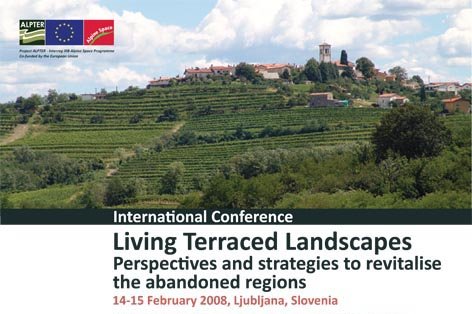
From the project final conference, held in Ljubljana, it is still possible downloaded the presentations held by the speakers, experts of international level about landscape and territorial management. It is also available a conference photogallery and the original conference website
PRESENTATION OF THE PROJECT
Interreg project ALPTER was conceived to counteract the abandonment of terraced agricultural areas in the alpine region, a problem that only during the last years has risen the attention of both institutions and population, for the loss of cultural heritage and the natural hazard that it can produce.
The project, co-financed in the framework of EU programme Interreg Alpine Space, started in 2005 with the the collection of data on 8 terraced areas, that now are being being elaborated to define procedures with regard to significant topics such as mapping, assessment of geological hazard, enhancement of agricultural production or promotion of tourism in terraced zones. Recovery works are meanwhile being realized in the study areas, to produce some examples of effective recovery of terraces to present and diffuse.
The first project international workshop was held in Genoa in 2005, while the second is scheduled for February 2007 in Venice. The project activities will conclude at the end of 2007: with the results two publications are foreseen - an ‘Atlas of terraced landscapes of the alpine region’ and a ‘Manual for recovery of terraces’.
Check the status of the project.
THE NETWORK FOR TERRACED LANDSCAPES
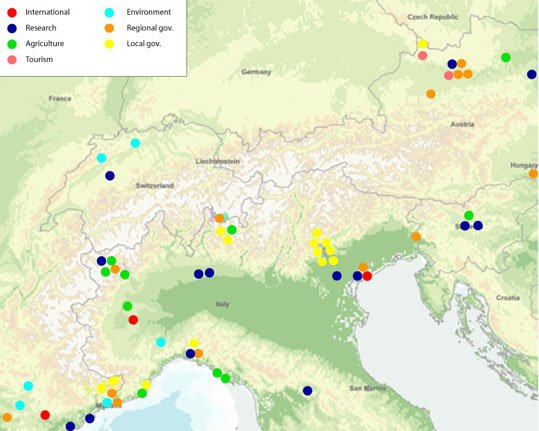
This initiative aims at linking institutions and associations from different sectors, involved in the fight against abandonment of terraced areas. So far the network counts more than 70 members, which can be localized from the above map. The members are organised into seven categories:


